Featured work
ATIS Replatform
Relaunching a B2B service for tourism operators, supporting growth in Alberta's $13B visitor economy (+12 NPS at launch).

Background
Travel Alberta's ATIS listing service, a B2B platform connecting tourism operators with international travellers, had become outdated and was no longer meeting the organization's needs.
However, shutting it down would remove the primary source of truth for operator data, break integrations with regional marketing partners, and wipe out 2/3 of website content on TravelAlberta.com.
The service needed to be retired or rebuilt — we chose to rebuild.
This multi-year program stretched my leadership skills in strategy, design, and delivery. As Director of Product & UX, it was my responsibility to oversee the multi-year road map, align design and engineering teams, build relationships with stakeholders, and clarify the product vision.
The Results
- +12 point improvement to NPS
- 6500+ listings, and 5000+ user accounts migrated
- 80% of listings renewed in the first 4 months
- Most complex launch ever for Evans Hunt
Product Discovery
Through interviews with operators and marketing partners, we assessed user needs for a variety of groups.
- Operators (external) wanted marketing exposure and growth opportunities.
- Marketing teams (internal + external) needed reliable content for promotion.
- Tourism Development teams (internal) wanted accurate product inventory data.
We also noted success stories and a clear desire for enhancements, demonstrating the potential impact if the platform could be revitalized.
- Listing pages represented ⅔ of content on TravelAlberta.com and generated more than half of the website’s search traffic.
- The platform’s API was powering business directories for 8 marketing partners.
- Thousands of tourism providers had signed on to create listings for their business.
- Users seemed to be genuinely invested in the quality and content of their listings.
With this information, the team prepared and validated a new concept direction with a Figma prototype. Users expressed strong agreement that it was an improvement (6.25/7) and that it would be a valuable tool to help them grow their business.

I synthesized these initial findings into a proposal that balanced operator needs (easier listing management) with internal stakeholder goals (reliable data, marketing content), and technical constraints (database migration, maintaining API integrations).
The end result was stakeholder buy-in and executive approval to move forward with a full re-platforming project.
Early Design & Planning
Praesent commodo cursus magna, vel scelerisque nisl consectetur et. Fusce dapibus, tellus ac cursus commodo, tortor mauris condimentum nibh, ut fermentum massa justo sit amet risus. Etiam porta sem malesuada magna mollis euismod. Vestibulum id ligula porta felis euismod semper. Donec ullamcorper nulla non metus auctor fringilla.
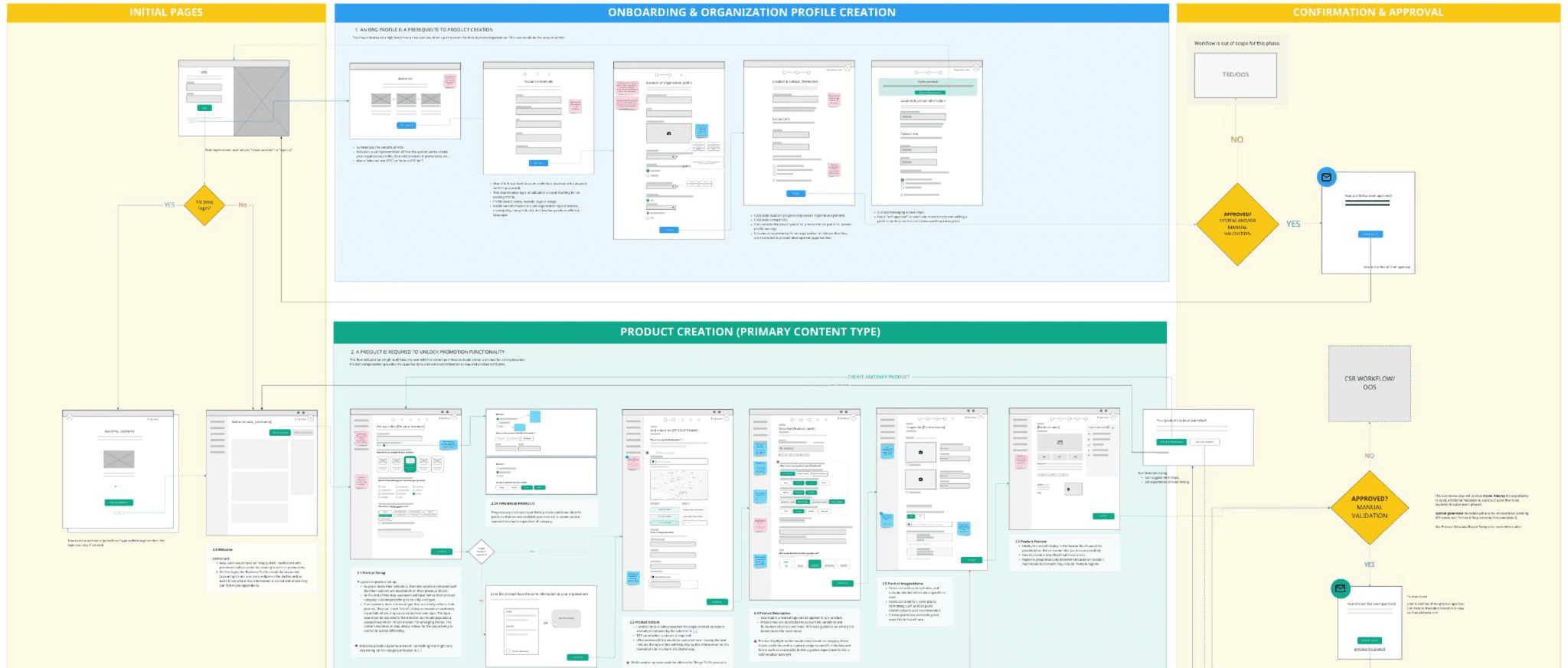
Duis mollis, est non commodo luctus, nisi erat porttitor ligula, eget lacinia odio sem nec elit. Donec ullamcorper nulla non metus auctor fringilla. Donec id elit non mi porta gravida at eget metus. Cras mattis consectetur purus sit amet fermentum. Vivamus sagittis lacus vel augue laoreet rutrum faucibus dolor auctor. Nullam id dolor id nibh ultricies vehicula ut id elit. Cum sociis natoque penatibus et magnis dis parturient montes, nascetur ridiculus mus.
Final Design & Delivery
Duis mollis, est non commodo luctus, nisi erat porttitor ligula, eget lacinia odio sem nec elit. Donec ullamcorper nulla non metus auctor fringilla. Donec id elit non mi porta gravida at eget metus. Cras mattis consectetur purus sit amet fermentum. Vivamus sagittis lacus vel augue laoreet rutrum faucibus dolor auctor. Nullam id dolor id nibh ultricies vehicula ut id elit. Cum sociis natoque penatibus et magnis dis parturient montes, nascetur ridiculus mus.


Database Migration
In addition to design and development, migrating legacy content was an essential step on the path to launch. The migration required untangling a gnarly web of unreliable data as well as deep understanding of both the old and new systems, so I stepped in to lead the planning.
The work was high stakes, too. Operators had already expressed frustration over previous launches, meaning that a cumbersome migration — or worse, forcing users to start from scratch — risked eroding trust and undermining adoption.
Timeframe
- ~4-6 months to plan / execute
Scope
- Transition 5,100 user accounts, 2,100 organizations, and 7,800 listings with minimal disruption
- Map legacy content model (~40 product categories) to new taxonomy datasets (~150 product types)
- Design user flows for claiming accounts, updating listings and resolving migration issues


Data Analysis
Ensuring that the right users were assigned to the right listings was clearly table stakes, but with unreliable data from the old platform and organization model changes that didn't have a straightforward mapping, the path forward wasn't immediately obvious.
So I rolled up my sleeves and dove into the data:
- I started with a combination of live website data and a CSV export to get a high level view of accounts and listings.
- The exported data was extremely messy and unstructured, requiring a great deal of persistence, careful pattern recognition, and gut-checking versus the live system.
- While reviewing, I created a Miro board documenting pseudo-scripts and logic statements (i.e. “if listing attribute = x, assign to y”) for discussion with the Technology team.
- I also invited a Data Analyst to stress test my thinking. She built an interactive Looker Studio visualization, that helped confirm some assumptions and aid discussion.
- Finally, I organized regular team check-ins to discuss progress and align on a high level plan.
[insert screenshot of excel spreadsheet?]
Working closely with the technology team, we mapped out and iterated on programmatic scripts before executing a final migration. Manual validation was used to confirm high value accounts and listings were mapped accurately.
Ultimately, the migration work set up a launch day with no major issues. Taking the time to implement such a seamless migration helped demonstrated to users that Travel Alberta was committed to building the new platform right.
Road Map & Next Steps
Etiam porta sem malesuada magna mollis euismod. Curabitur blandit tempus porttitor. Lorem ipsum dolor sit amet, consectetur adipiscing elit.
"Your team has been kicking butt and taking numbers — moving us from unstable, weary products to a foundation that can lead us into innovation. Thank you for creating a culture of excellence with folks that truly care about the work we do."
- Exec Stakeholder Feedback
Assets and more
Reflection
The ATIS project stretched every product leadership muscle I had — discovery, strategy, stakeholder management, technical delivery, risk mitigation, and more. In fact, I was so invested in the work that the team took to calling ATIS my second child (my wife and I had our first - a boy - in the months leading up to launch, one of three babies born in the timespan of this program).
Our Head of Technology at Evans Hunt took to calling this "the most complex project Evans Hunt had ever delivered", but even this didn't account for the two years of discovery, planning, and stakeholder discussions leading up to the design & delivery phase.
Although many aspects of the work weren't glamorous, ATIS is an essential platform for the tourism operators who rely on Travel Alberta's support, and for the internal teams working to grow the province's tourism economy.
The relaunch and migration were also the kind of high stakes work where you don't get a second chance if you don't get it right, so there was a lot of pressure to deliver. Moreover, the ATIS project became a key symbol for Travel Alberta transforming from a traditional marketing organization to become more product-led.
Yes, the work was hard. And without question there are elements of it that I would do differently next time. But this was the kind of opportunity for impact that every product leader covets. To be able to do it in an agency setting, with an incredible team, was doubly fortunate.